Does this concern you?
- Affected: Linux machines serving NFS with NFSv4.1 or 4.2 (a default in many distributions, says CSO Online) on unfixed kernels: file servers, NAS boxes, build servers, Kubernetes storage nodes.
- Skip it if: no Linux machine or NAS box of yours has the NFS server (nfsd) running.
What to do
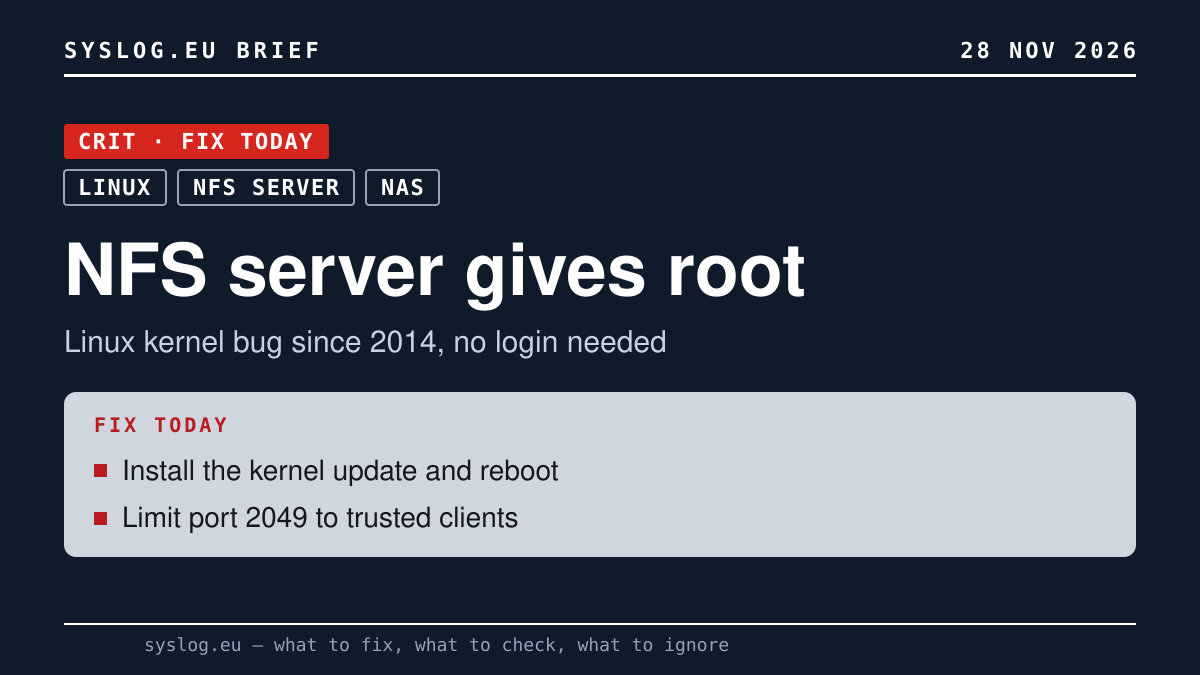
- Install your distribution's kernel security update and reboot, so the fixed kernel actually runs. Fixed stable kernels: 5.10.275, 5.15.226, 6.1.193, 6.6.163, 6.12.117, 6.18.61, 7.3.2, 7.4-rc1; distributions number their own, so look for the CVE in their advisory.
- NAS and appliances may run older kernels and get fixes only as firmware (CSO Online): look for a firmware release naming this CVE.
- Until then: allow port 2049 only from trusted clients with a firewall rule. Not sharing over NFS? Stop and disable nfs-server. Or switch off NFSv4.1 and 4.2 in /etc/nfs.conf and restart nfsd; CSO Online notes this disables pNFS and some features.
- Signs of an attack (OpenSec; no network signatures exist): nfsd4_check_resp_size kernel warnings, shells started by kernel workers, bursts of short NFSv4.1 sessions from one source, kernel oopses with nfsd4_, svc_ or call_usermodehelper* frames.
- Don't: count on kernel hardening; OpenSec says it "does not remove the overflow".
What we know – and what we don't
- Jérémy Jean of the French agency ANSSI found the bug in August; his fix entered the mainline kernel on 14 September. OpenSec found it independently with an AI-powered testing harness. The CVE ID came only on 19 November, after backports (CSO Online).
- Who can attack: TechRadar and Mezha require port 2049 reachable from the internet; CSO Online and OpenSec say anyone who can reach the port, which includes your own network.
- Public exploit: only TechRadar's summary says exploit code is public. Its body and Mezha say OpenSec shared an exploit with the kernel maintainers; CSO Online, that OpenSec published technical details.
- No exploitation is reported; CISA's catalog of exploited flaws did not list it on 27 November. OpenSec expects attacks in the coming days and weeks.
- Not known: which NAS models are affected and when their vendors ship fixes.
Why it matters
NFS lives inside the office network, and in our view that is why it gets forgotten. Root on a file server opens everything on it, and the NAS in the cupboard will likely wait longest for a fix.