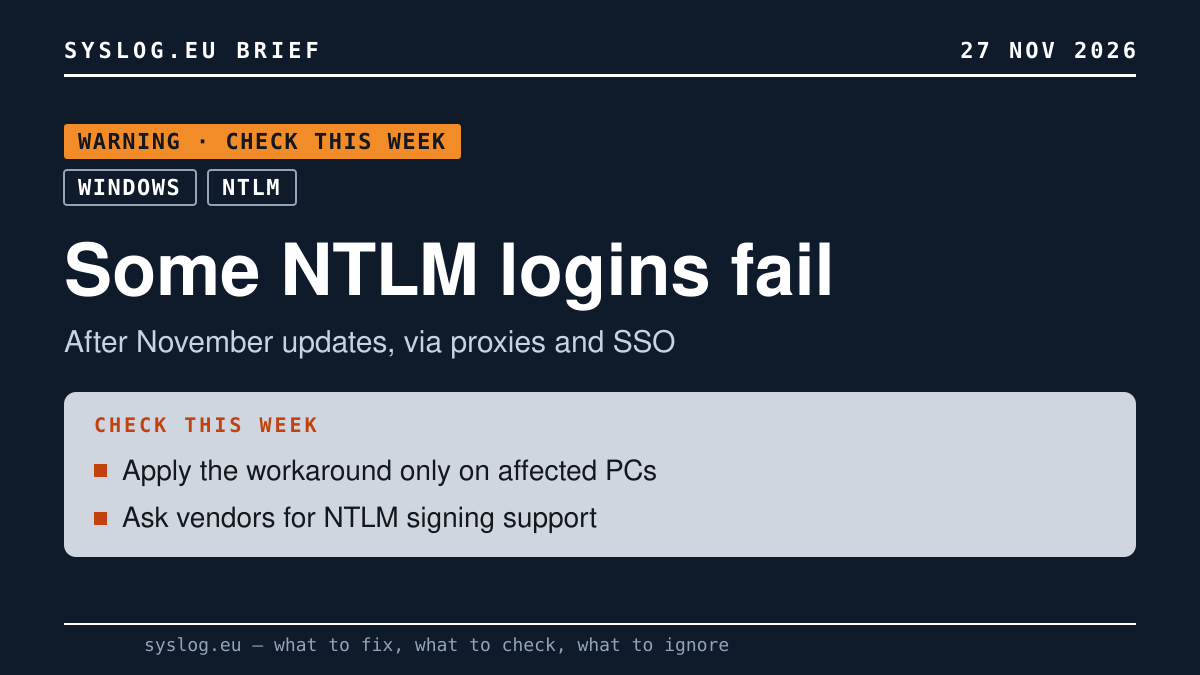
Does this concern you?
- Affected: organisations with Windows clients that sign in over NTLM through another vendor's proxy, SSO product or packaging tool.
- Skip it if: your apps and devices authenticate only with Kerberos, which the change does not touch.
What to do
- Check whether sign-ins through such products started failing after the November updates. Windows rejects them with STATUS_LOGON_FAILURE; look for an empty Target Info List in network traces or Event 4021 entries showing a Target Information value of "Not Found".
- Only on the affected PCs, set ClientAllowUnsignedNtlm (REG_DWORD) to 1 under HKEY_LOCAL_MACHINE\SYSTEM\CurrentControlSet\Control\Lsa\MSV1_0. The client then stops offering signing and loses the new relay-attack protection.
- Ask the vendor of each affected product for an update that follows the NTLM specification, or switch the product to Kerberos. Microsoft calls this the long-term fix.
- Set a deadline: from May 2027 servers will require signing and turn away PCs on the workaround; Microsoft may also remove the key.
- Not rolled out yet? gHacks advises testing the November updates with these products and checking with their vendors first.
- Don't: roll the key out to every PC by policy "just in case"; the sources advise using it only where sign-ins fail.
What we know – and what we don't
- Phase one (November 2026): clients offer NTLM signing on every non-anonymous connection; servers still accept unsigned clients and log audit events. Phase two (May 2027): servers require signing by default.
- Failures usually come from devices that set the TARGET_INFO flag but send an empty or incomplete TargetInfo field.
- The November updates ship as KB5132061 (Windows 11 26H2, 25H2 and 24H2 Enterprise and Education), KB5131087 (23H2) and KB5132059 (26H1).
- Notebookcheck and the CVE record describe CVE-2026-118737 (CVSS 8.1) as improper verification of a cryptographic signature; gHacks calls it a timing-dependent authentication weakness. CISA's assessment in the record (10 November) lists no exploitation.
- Microsoft has announced no Windows-side fix. According to gHacks, it has also confirmed activation failures and SQL Server slowdowns with the same updates and is investigating a printing problem.
Why it matters
In our view the workaround is the trap here. It makes the help desk calls stop, but it quietly switches off the new relay protection the update brought, and it stops working in May 2027. Listing where it is set, each entry a vendor ticket with a deadline, keeps it temporary.