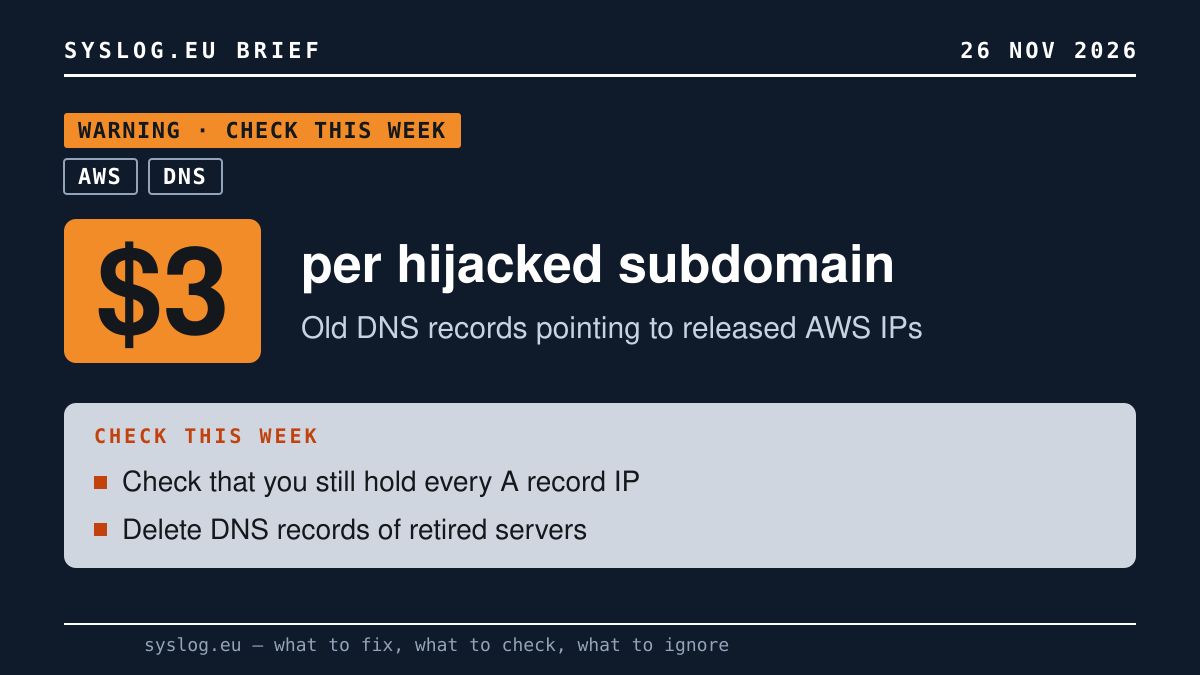
Does this concern you?
- Affected: any organisation whose DNS has A records pointing to AWS addresses, whether the records are kept by you, an MSP or a web agency. Intruder tested no other clouds or hosts; in our view the check is worth doing there too.
- Skip it if: every A record points to an address you still hold, which only a check tells you.
What to do
- Export the A records of all your domains, including test, campaign and old project subdomains.
- For each address, confirm it is still yours: in AWS, compare against the Elastic IPs and public IPs in your accounts; for other hosts, ask whoever runs them.
- Before deleting a record that points elsewhere, check what the subdomain serves now. If a stranger's page answers, find scripts and integrations still sending data or logins there and change those passwords and keys.
- Delete records that point to addresses you no longer hold.
- When you retire a cloud server, remove its DNS record as part of the shutdown.
- Ask your web agency or MSP for the same check, with a date.
What we know – and what we don't
- In 48 hours Intruder cycled through 450,000 unique addresses, under 1% of the roughly 80 million AWS publishes for EC2, before AWS blocked the account; the matched addresses could still be moved to another account in the same AWS organisation.
- AWS says rapid allocation and release breaks its policy and that it has controls against it; Intruder says the ban hit one account and was easy to route around.
- Almost half of the 28 takeovers belonged to government bodies. The Treasury records were reported through a bug bounty programme and removed.
- Whoever holds such an address controls what the subdomain serves, can get a trusted TLS certificate for it, collect data that old automations send there and receive cookies set for the whole parent domain.
- Intruder estimates that, if bans apply only per account, ten accounts could sweep the published EC2 space in about five weeks. No source reports criminals using this method now.
Why it matters
In our view this is housekeeping, not a vendor bug, and that is why it lingers. Usually nothing raises an alert when a server is switched off and its DNS record stays behind, yet the record keeps lending your domain's trust to whoever picks up the address next.