Does this concern you?
- Affected: any company whose internal web applications (HR, payslips, timesheets, expenses) can be reached from the internet. The Commission has not said how the attackers got in; the lesson is the general one.
- Skip it if: none of your internal applications answers from the internet, and remote staff reach them only through a VPN.
What to do
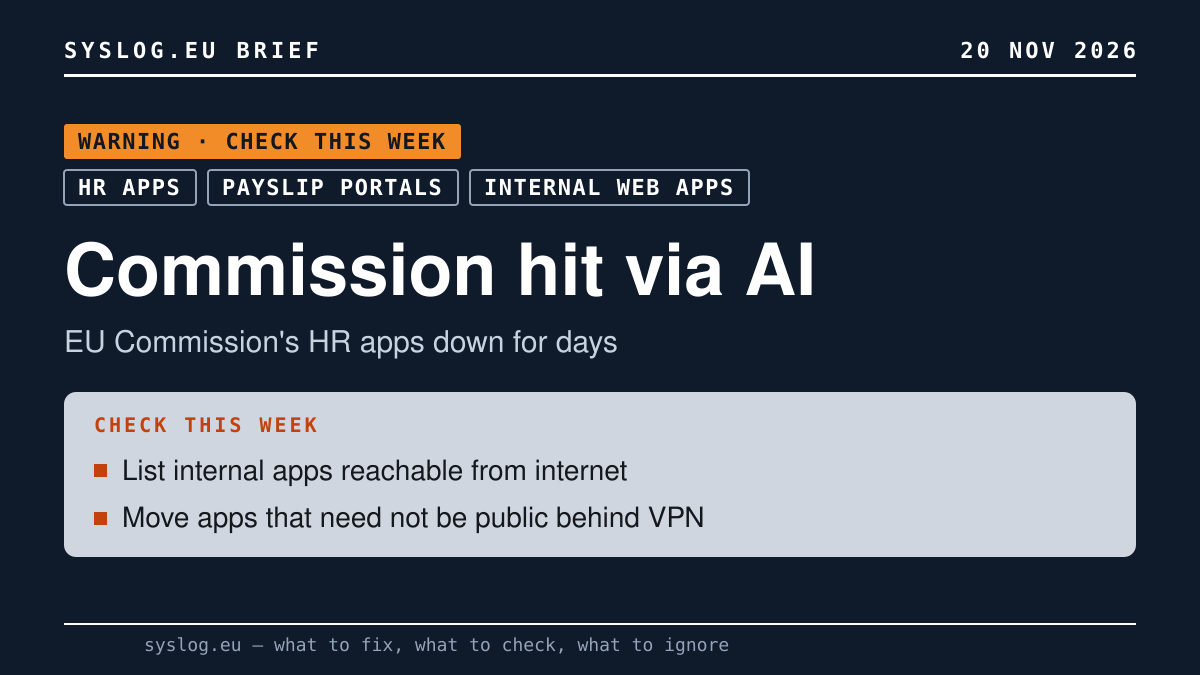
- List internal applications reachable from outside, starting with your firewall's port forwards and your domain's public DNS records.
- Check that each is updated and has a named owner.
- Move those that need not be public behind your VPN. For an HR system you rent as a service, ask the provider in writing whether sign-in can be limited to your addresses.
- In the logs of each exposed app, look for sign-ins you do not recognise and bursts of requests to many pages from one address.
- Agree in advance what staff hear when you take a system offline: what is down, why, and when they hear more. Three officials told Politico that IT cited only a "general functionality issue" for a Sysper fault.
What we know – and what we don't
- The spokesperson confirmed that AI tools were used, called it a campaign, a series of incidents, named no culprit and knew of no ransom demand.
- Detection: the spokesperson says the incident was detected on 22 October and confirmed on 26 October. Politico reports that CERT-EU established earlier in November that ARTEX was used.
- Taken offline during a disruption of about ten days, according to Politico: Sysper, the MyPMO medical reimbursement system; translation services were hit too. Salaries were paid on time.
- Status: Politico says Sysper and MyPMO returned in the week of 16 November, then Sysper briefly failed again; Euronews says the JSIS health insurance system was still down on 19 November.
- Personal data: Politico-based reports say a large amount may have been exposed; the spokesperson said there are no indications of a breach affecting all Commission staff. Euronews notes the HR systems hold names, pay grades and home addresses.
- Not known: which weakness was used, who is behind it and whether any data was taken.
Why it matters
An address nobody publishes used to be a weak form of protection; a public tool built to look for weaknesses makes it weaker still. A current list of what you expose costs less than days of explaining why the HR system is down.