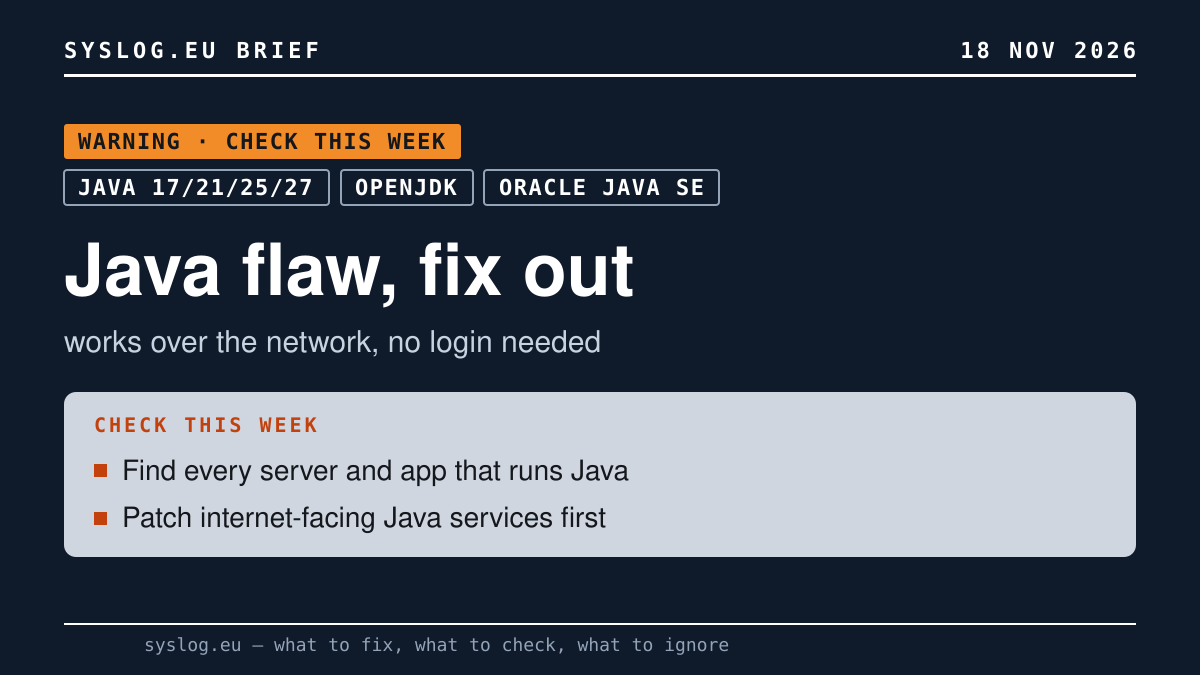
Does this concern you?
- Affected: anyone running an affected build of Java 17, 21, 25 or 27: on a server, from a Linux distribution, bundled in a vendor's application or in a container image.
- Skip it if: no Java 17, 21, 25 or 27 runs anywhere in your company, bundled copies included. Java 8 and 11 are not hit by this CVE, but the same release fixes other flaws in them.
What to do
- Make a list of every Java runtime with its version, build and operating system, as NIS recommends.
java -versionshows only the Java on the PATH; also look in application folders for their ownjavabinary, and ask vendors about the Java inside their products. - Check the build: OpenJDK lists 17.0.21, 21.0.13, 25.0.5, 27.0.1 and earlier as affected.
- Oracle Java SE and GraalVM: install the November Critical Security Patch Update.
- Temurin, Corretto, Zulu, Microsoft, Red Hat or distribution builds: install the vendor's fixed build when it appears; its number may differ. Temurin had none on the evening of 17 November.
- Start with services reachable from the internet. Until they are patched, block external access that the work does not need.
- Bundled Java: ask the vendor in writing when its fixed release ships. Container images: rebuild on a fixed base image once it ships.
- Signs of compromise: none have been published. Aikido knows of no workaround; patching is the fix.
- Have backups and a recovery procedure ready, as NIS advises.
What we know – and what we don't
- OpenJDK rates the flaw 8.1 under CVSS 3.1: network attack, no privileges or user action, but high attack complexity.
- Seoul Economic Daily and Aikido report 9.2 under CVSS 4.0 and "OpenJDK 17.0.6 and later"; OpenJDK names only four lines. Aikido notes that Oracle's highest Java score this month is 8.1 and that the two figures may describe different issues.
- Oracle's announcement lists 11 Java SE fixes; all may be exploitable remotely without authentication.
- Aikido had seen no exploitation as of 17 November, and the CVE is not in CISA's catalogue of exploited flaws.
- Unknown: which code paths are exposed. Calif said it would publish technical details after Oracle's release.
Why it matters
The patch is the easy part. The hard part is the Java nobody remembers because a vendor's application or an old container image brought it along.