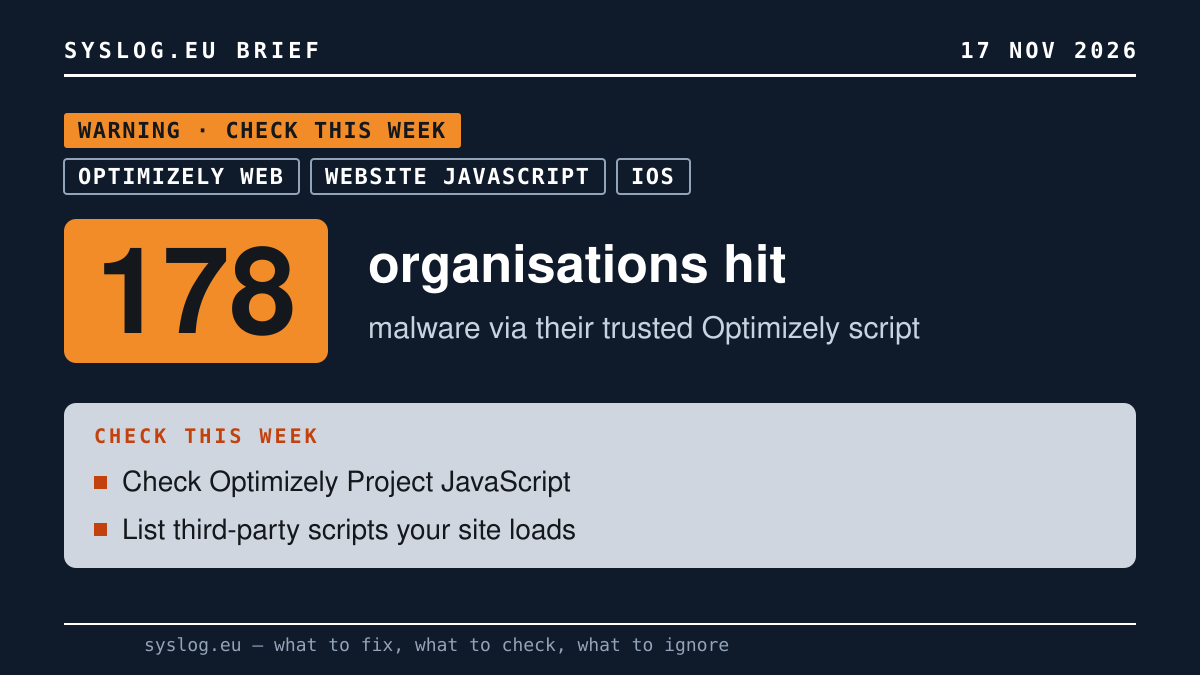
Does this concern you?
- Affected: companies whose website loads Optimizely Web (also from their own domain), and visitors of affected sites on 16 November.
- Skip it if: your site does not use Optimizely Web and staff iPhones are up to date.
What to do
- Optimizely customers: search every project's Project JavaScript and experiment custom code for
1688360.cc,atob(and anything you did not write. Most snippets were cleaned that evening, so also check Report URI's list; it shares its archive with affected organisations. - Review who can write to the Optimizely account (users, API tokens, integrations) and rotate credentials.
- Optimizely customers with their own card forms: treat cards entered on 16 November as potentially exposed; hosted payment frames such as Stripe or Adyen were out of reach. Rotate session tokens in non-HttpOnly cookies, and decide whether to tell your customers your site served them malware.
- Any company website: list its external scripts and who can change them. Start a Content-Security-Policy in report-only mode, then enforce script-src and connect-src with only the hosts you need, avoiding 'unsafe-eval' and 'strict-dynamic' where you can.
- Staff iPhones and iPads: update to iOS 18.7.3 or later, or 26.3 or later (patched, per the kit's comments).
- Don't: rely on allowing the provider's domain; the code came from it.
What we know – and what we don't
- The attacker wrote code into the customers' Project JavaScript field, which runs on every page; it was not CDN cache poisoning.
- The script swapped cryptocurrency wallet addresses, skimmed cards typed into a site's own forms from 13:43 UTC, sent cookies and screenshots out and, on iPhones and iPads, loaded iOS exploit kits. The attacker's wallets had received about $7,040 by 19:25 UTC.
- Of 256 crawled hosts of affected organisations, 24 blocked the payload with a strict script-src. Where a CSP blocked the loader but allowed 'unsafe-eval', an inline copy still ran, as at HSBC; Optimizely's documentation tells customers to allow it.
- By 21:52 UTC only 1 of 188 infected snippets still carried the code; Smartsheet's was re-infected after cleaning, a sign the attacker still had access.
- amirulcyber's 15 captured page loads, some not via Optimizely, measure something else.
- Unknown: how the attacker got write access to so many projects, and how many cards were taken. Optimizely had not answered Report URI.
Why it matters
Patched servers are not enough when someone else writes part of the code in your visitors' browsers. A report-only CSP breaks nothing and shows what your pages load.