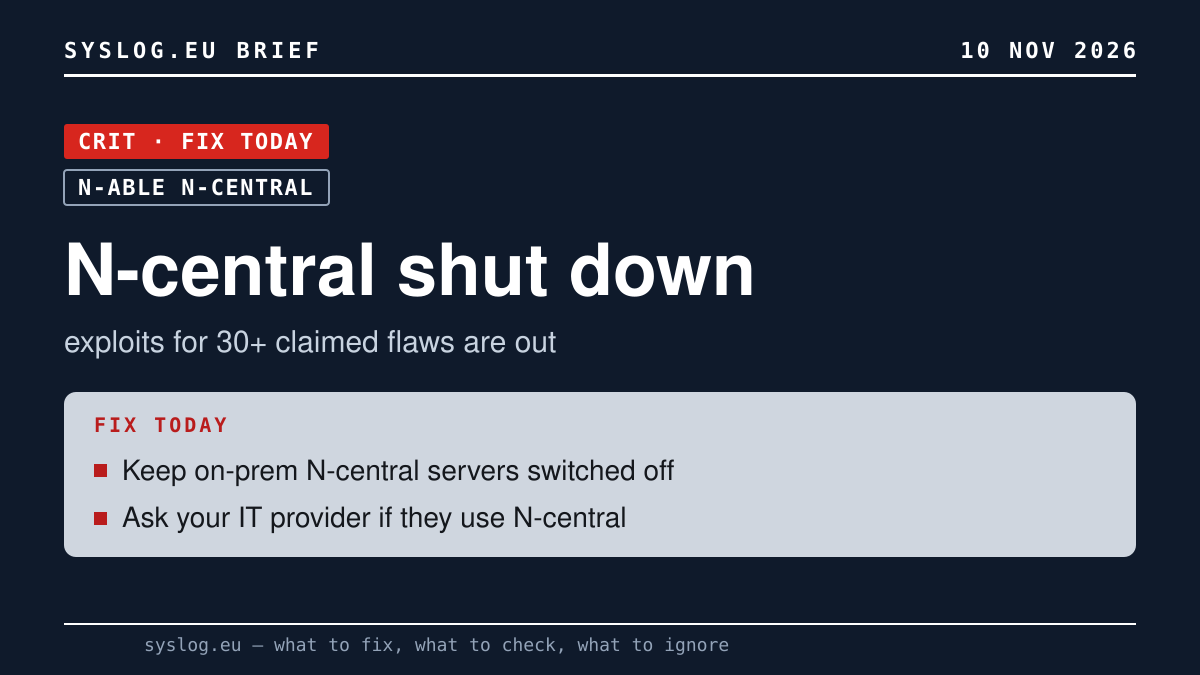
Does this concern you?
- Affected: IT teams and managed service providers (MSPs) running N-central, hosted or on-premises – and every company whose IT provider manages its machines through it.
- Skip it if: neither you nor your IT provider uses N-central.
What to do
- On-premises N-central: take the server offline now and leave it off until N-able says it is safe, as N-able advises.
- Hosted N-central: it is already down; N-able promised status updates every four hours.
- No N-central of your own but an outside IT provider: ask them today, in writing, which RMM tool reaches your machines and, if it is N-central, whether they switched it off and checked its logins since November 8.
- Look for signs of a break-in from November 8 onward: unexpected logins to N-central, new administrator accounts, including an enabled Default Administrator, unfamiliar remote sessions and scripts pushed to managed machines (Huntress, BleepingComputer). If you find any, treat the managed networks as possibly affected too.
- Don't: switch the server back on before N-able ships the fix and gives the all-clear. The August and September hotfixes fixed other flaws (Huntress).
What we know – and what we don't
- The flaws reported include authentication bypass, credential disclosure, arbitrary file write, path traversal, XSS, XXE and remote code execution. The chain the researcher calls the worst starts with an XXE that needs no login and ends with commands running on the server and an attacker-controlled Default Administrator account (BleepingComputer, via Mezha).
- Huntress and RuntimeWire count 33 flaws; Huntress says they form four exploit chains, three ending in remote code execution and one in root access. Mezha's report of BleepingComputer's story says "more than 30".
- The researcher tested N-central Appliance 2026.4.0.31 and believes most or all of the flaws also affect older versions.
- BleepingComputer did not verify every claimed flaw, but N-able confirmed it is building an urgent fix.
- N-able says it has seen no active exploitation or unauthorised data access. It has given no date for the fix or the restart.
Why it matters
An RMM server can run commands on every machine it manages, so one hacked server can mean many hacked customers. In September N-able patched a different N-central flaw, CVE-2026-86218, that attackers were already exploiting; according to Huntress, they pushed scripts and tools to managed networks. In our view, ask your provider which remote tool reaches your machines, whatever it is.