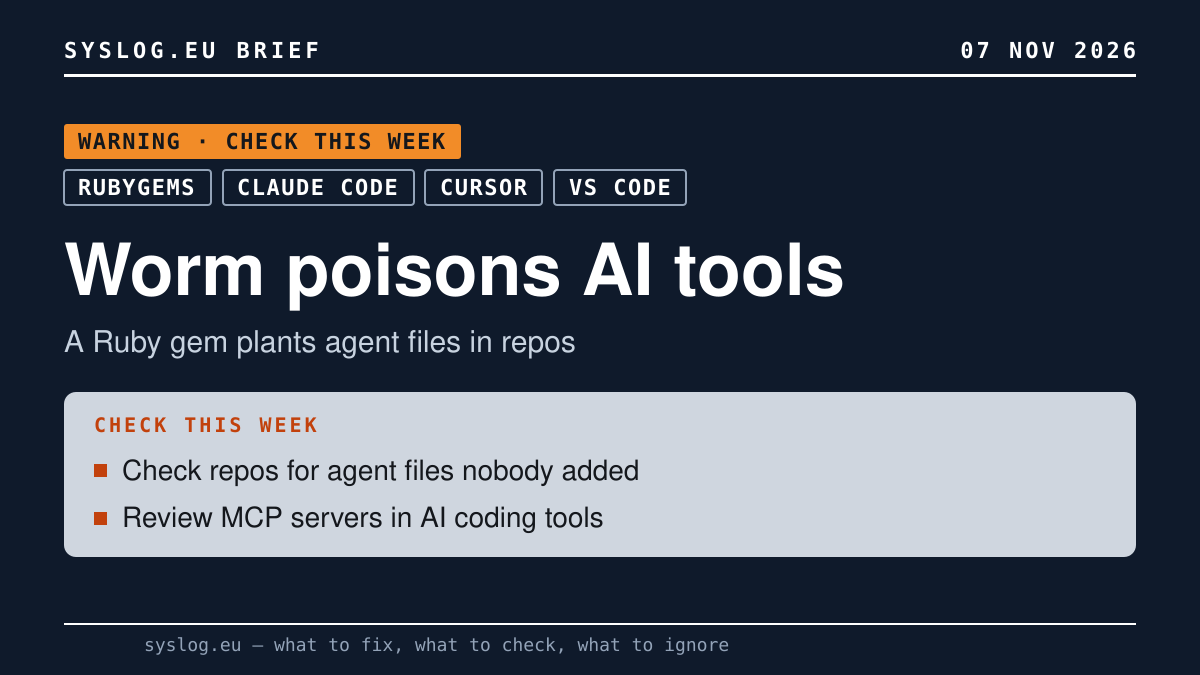
Does this concern you?
- Affected: directly, machines that installed strutil-core 1.0.1. In our view, any team whose developers install open-source packages and use AI coding tools (Claude Code, Codex, Cursor, Gemini) or VS Code should look for the planted files.
- Skip it if: nobody at your company installs packages or runs coding agents.
What to do
- If you use Ruby: search Gemfile.lock files, CI caches and container images for strutil-core.
- In repositories and home directories: look for changes nobody made to AGENTS.md, CLAUDE.md, .claude/settings.json, .cursor/mcp.json, .gemini settings, .vscode/tasks.json or .github/init.js, for an MCP server (a tool the AI assistant can start) named workspace-tools, and for SessionStart hooks (commands run when a session starts).
- Signs of infection: services named pkg-runtime or net-health-checker, the files ~/.config/index.js or /var/tmp/.fontconfig_state, new public repositories in your GitHub organisation described as project-utils, or commits containing AutoSyncComplete.
- If a machine is infected: isolate it. Remove net-health-checker and pkg-runtime, then revoke the GitHub token, rotate every credential the machine could reach from a clean device, and rebuild it. Removing the gem is not enough.
- Don't: revoke the GitHub token first – a failing token makes net-health-checker delete the user's home directory.
- In our view, keep workspace trust and approval prompts on; Socket says whether opening a repository re-runs the worm depends on them.
What we know – and what we don't
- A clean 1.0.0 preceded the malicious 1.0.1 by under two hours. Socket found no projects depending on the gem and has confirmed no victims.
- In Bitbison's sandbox, the gem read files such as .claude/.credentials.json and .codex/auth.json. Socket's other findings come from the code.
- The planted AGENTS.md tells agents to run a setup script before their first command; the VS Code task runs when the folder opens.
- The code can republish npm and PyPI packages; Socket has seen none from this gem. How many systems installed it is unknown. A PyPI package, pystr-codec, uses the same collection server.
- Socket ties the worm to the Miasma family built on the Shai-Hulud toolkit, public since May 2026, so shared code does not prove one operator.
Why it matters
Agent instruction files look like documentation, and nobody reviews them like code. Yet a coding agent follows them. A repository is now something your tools act on, not just read.