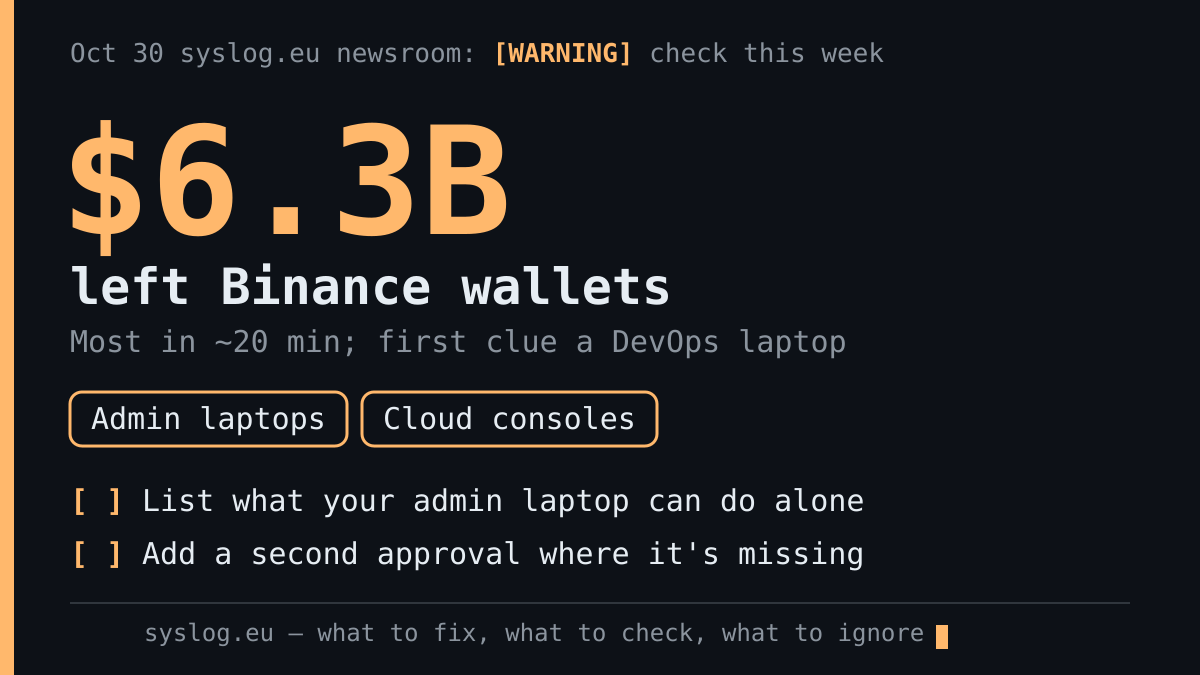
Does this concern you?
- Affected: as a pattern, any admin or DevOps person whose own laptop reaches production, a cloud console or a payment function with nobody else signing off.
- Skip it if: no single person's device in your company can change production or release money on its own.
What to do
- Write down what an admin laptop reaches today: servers and containers, the cloud console, deploy pipelines, the bank portal. Mark where one person can act alone, and whether anyone would notice it at 3 a.m.
- Where money leaves the company, switch on a second approver in the bank portal. With no second admin for production, send change logs to someone else. Keep deploy rights and payment rights with different people or accounts.
- Know who can quickly pause jobs that run by themselves. During the attack, Coinbase's Conor Grogan said on X that Binance's automatic deposit sweeps appeared to keep topping up the hot wallet the attacker already controlled.
- Don't: read "no keys leaked" as "nothing to fix". Binance found no evidence of a private key leak, yet the withdrawals went through.
What we know – and what we don't
- Binance's preliminary account (Gizmodo, MLQ.ai, Gadget Review): a compromised laptop may have let the attacker into a service container, from which unauthorized withdrawal transactions were sent.
- The cause is not settled. Co-CEO Richard Teng says the attacker did not just use one engineer's permissions and it was no "one-click" action. NyxLab's Kok Tin Gan, quoted by AP (via Courthouse News), says it looks like "one signature" gave the attacker a never-expiring, full-access token to a Binance hot wallet. No technical post-mortem has been published.
- The size moved during the coverage. Binance now says about $6.3 billion; TRM Labs says about $6.36 billion left Binance wallets on ten blockchains, most of it within roughly 20 minutes.
- Binance says roughly $3 billion is frozen; Tether and Circle report their own freezes, which MLQ.ai notes need not match Binance's total.
- TRM Labs names TraderTraitor, which it calls a North Korean unit, with high confidence; Chainalysis and Elliptic also point to North Korea. These are private-sector assessments, not a law-enforcement finding.
Why it matters
Many small companies have their own version of that laptop: the one machine that deploys, opens the cloud console and logs in to the bank. In our view the useful question is not how good your antivirus is, but what an attacker could finish from that seat before a second human looks.